
Crisis Engineering: The Book
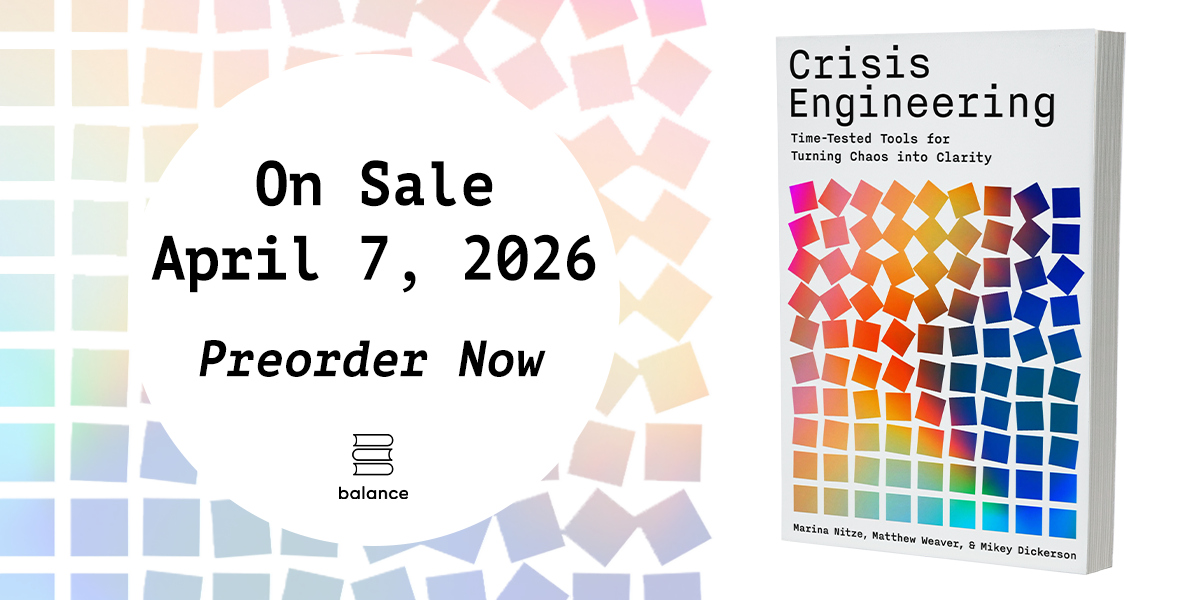
Our new book, Crisis Engineering, comes out April 7, 2026, everywhere books are sold, as a paperback, and audiobook (read by Cassandra Campbell).
For bulk orders below 500 copies, purchase on BulkBooks. For bulk orders over 500 copies, please contact marina@layeraleph.com.
Crises are no longer rare events. They are the operating environment.
From public infrastructure and digital systems to global corporations and hospitals, the systems we rely on are failing in public, under pressure, and at scale.
Crisis Engineering starts from a hard truth most leaders avoid: crises are not just events to survive, but rare and powerful catalysts for transformation.
"Crisis Engineering is the ultimate practical guide to leveraging a crisis to drive meaningful change. The authors—veterans and students of crises—provide both thoughtful analysis and compelling logic to provide a toolkit for making sense of what’s happening, understanding the systems involved, and reshaping them. A book I wish I’d had in difficult times."―General Stanley McChrystal, US Army (Ret) & Co-Founder and CEO, McChrystal Group
Crisis Engineering makes a radical but practical claim: resilience is not a personality trait, but a design problem.
We introduce a practical systems-based approach to understanding and repairing an organization in real time. Drawing on decades of experience inside failing systems from national infrastructure to technology failures, we show how to engineer resilience through structure.
Resilience, in this framing, is not about toughness or endurance. It is about clarity, adaptability, and redesign. When done right, uncertainty becomes a source of learning and long-term strength rather than repeated failure.
"This is the book I wish every single boss I ever worked for had on their desk."―Dan Davies, Cyberneticist, author of The Unaccountability Machine and Back of Mind Substack
Crisis Engineering introduces a set of practical frameworks for understanding and repairing systems under stress.
At the center is the crisis lifecycle, a recurring pattern of signal, shock, response, and renewal. The book explains why weak signals are missed, responses break down, and organizations fail to learn once the crisis passes. It then gives leaders concrete ways to intervene at each stage.
"Crisis Engineering is a field guide for anyone trying to make change with urgency, humility, and heart."―Jen Pahlka, author of Recoding America and Former U.S. Deputy CTO
We apply an engineering mindset to institutions and human systems, treating organizations as things that can be diagnosed, tested, redesigned, and improved. We explore how adaptive infrastructure, redundancy, and optionality make systems more flexible under pressure, and why tightly optimized systems tend to fail catastrophically when conditions change.
"This book gives you the tools to recognize a crisis, steer out of it, and maybe even make lasting change while you do. There's so much insight here: plenty of theory and useful new ways to think about crisis, but also practical tactics and detailed real world case studies. (And the nerdy sidebars are fascinating.)"―Tanya Reilly, principal engineer and author of The Staff Engineer’s Path
Human factors are treated as first-class design constraints, not soft add-ons. The book examines leadership under pressure, psychological safety, narrative control, and decision-making when information is incomplete and the clock is ticking. It also introduces post-crisis learning loops, methods for turning failure into foresight rather than letting organizations snap back to old habits.
"Crisis Engineering is the essential guide to facing the complex breakdowns that characterize the 21st century. Read it, and come away wiser, stronger, and readier to understand and deal with whatever comes at you."―Tim O'Reilly, founder & CEO of O'Reilly Media, and author of WTF? What's the Future and Why It's Up to Us
Throughout, diagrams and visual models illustrate how fragility and resilience emerge from structure, not intention, and how small design choices can determine whether a system collapses or adapts.
This is not a book of postmortems, hypothetical disasters, or abstract leadership theory. It’s a field guide for anyone responsible for a system that cannot afford to fail.
"The central fact of our era is the rot and stagnation of our institutions. Many words have been spent documenting and lamenting this state. Crisis Engineering's contribution is a theory of how to get out of it, focused on the moments where brittle systems break. It's written by doers for doers."―Patrick McKenzie, host, Complex Systems
Crisis Engineering is written for leaders, operators, policymakers, and professionals who are tired of playbooks that look good on paper and fall apart under load. It speaks to anyone responsible for systems that cannot afford to fail, and to anyone who wants to understand why modern institutions struggle to perform when the stakes are highest.
“Crisis Engineering is required reading for every decision maker in a complex company, non-profit, school, or government organization. This irresistible blend of theory, practice, and storytelling will help you avoid, reduce the duration and damage, and above all, take advantage of such unexpected, disorienting, and disruptive failures to make rapid system-wide improvements.”―Robert I. Sutton, Stanford Professor Emeritus and New York Times bestselling author of eight books including The No Asshole Rule, Good Boss, Bad Boss, and (with Huggy Rao) The Friction Project
"The world is never going to get less challenging, systems won’t get less complex, and the stakes won’t get lower. What’s more, the better you are at what you do – the more important and reliable your system is -- the worse it will be when a crisis hits. This book gives you the understanding and tools you need so that, when your organization is suddenly in the most demanding moments of its existence, you can act with confidence, resilience, and grace."―Deb Chachra, author of How Infrastructure Works: Inside the Systems That Shape Our World
“Crisis Engineering brings together insightful definitions, useful (and gripping) anecdotes, and decades of collective experience in the hot seat to help you not only manage and recover from a crisis, but to come out better.”―Jason Fraser, Impact Strategy Advisor and Co-Author of Farther, Faster, and Far Less Drama