Project Hail Mary Is a Master Class in Crisis Engineering

This whole post is spoilers. Beware.
I couldn’t stop thinking about crisis engineering as I watched Project Hail Mary, and what a great story it tells about recognizing and leveraging a crisis for transformative change.
Is it a useful crisis? You bet! It checks all five indicators:
- Fundamental surprise. Nobody's model of reality included "the sun is being eaten by microorganisms." That's not supposed to happen! You would be very surprised if this happened in the real world tomorrow.
- Degradation of core processes. The Earth's temperature is dropping on a known timeline, with increasingly catastrophic results. (In this context, at least, everyone seemed in agreement about this outcome.) In this case, the core process is “sustain life on Earth.”
- Breakdown of sensemaking. Dots eating the sun is not how the universe is supposed to work. The entire planet’s understanding of the story of the world, of science, and of the future of humanity is unraveled. Everyone is scared.
- High visibility. Every world leader across the entire planet is paying close attention.
- Rigid timeline. The human race ending is as rigid as it gets.
If that’s not a useful crisis, I don’t know what is — but that doesn’t mean anyone had to use it. The world could have thrown up their hands and given up. A doomsday cult could have taken over (though, I suppose that would also be leveraging the crisis). Humans also could, and may, have invested elsewhere in innovations to enhance humans’ ability to live in freezing temperatures, although an ever-diminishing sun seems difficult to truly outrun.
First up: Establishing the crisis engineering center
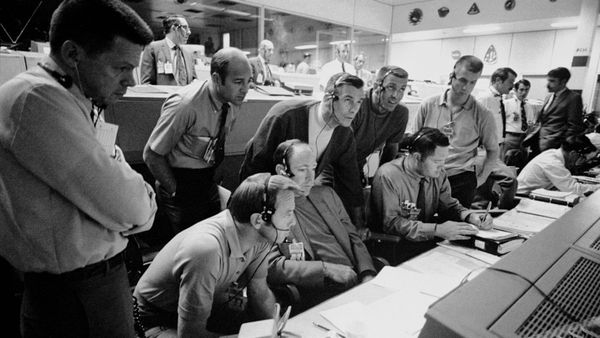
Dr. Stratt was the clear incident lead with delegated authority—she was able to grant Grace top-secret clearance on the spot, without a form or an approval chain. In a real crisis engineering effort, being able to make key decisions inside the room, without external authorization, is the whole point. Every decision that has to leave the room is a drag on progress.
World leaders assembled together in person in one room. (Okay, there was a video screen too; but given the caliber of leaders in the room, on the ship, I’m going to relegate the people on video to the B team.) Notice that many of those leaders also physically joined and observed Grace’s early experiments, instead of waiting back at the office for a report, even over the course of many hours. These all signaled to the entire world that it was not regular order.
Finding the right people
Dr. Stratt didn't call a meeting and check Outlook calendars for availability. She went around the world and surfaced the specific people who might have relevant knowledge—including Grace, a scientist who'd been professionally ostracized for believing that life might not require water. In a real crisis, the person with the most useful information is often the person nobody is currently listening to.
Dr. Stratt needed people who would bring a fresh perspective to the problem. When she found one, she put him on a jet to the middle of the ocean. She did not send a LinkedIn message asking if he had a few minutes to chat.
Novel Actions & Extreme Sensemaking
This is where the movie really delivers on the crisis engineering premise. The team isn't sitting around a table debating options —scientists all over the world try things in parallel.
The Home Depot box experiment wasn't meant to discover how astrophage reproduces, but that’s what happened, because they were taking novel actions and observing results. That's sensemaking. You don't think your way to the answer; you act your way there.
Sending a ship to another star is, obviously, a novel action. So is the 5km chain Rocky builds to collect an atmospheric sample when flying the plane that low isn't an option. When the obvious path is blocked, you don't give up—you try something new.
When Grace first wakes up, he is not entirely sure who or where he is. He does not work it out by looking for a note or manual — he takes lots of actions to try to work out who he is and why he’s there. He roams the ship. He opens luggage. He tries on everyone’s clothes. He downs a bag of vodka. He works backwards into the story of what happened and what his purpose is, by taking actions.
Later, on the ship, there’s a dry erase board serving as a shared crisis journal of actions taken and results. Even for a team of two, this log is critical to drive and inform future actions. Grace’s videos are also a form of logging his activities over time in this unusual context where he literally cannot communicate with the team back on Earth.
I could go on forever listing novel actions taken: using astrophage as a fuel source, using electrical wires as rope to reach Rocky’s ship, and breeding a nitrogen-resistant Taumoeba.
Communicating in a Crisis
The communication protocol Grace develops with Rocky is particularly good. He doesn't consult a textbook on linguistics, but rather dances, taps, talks, puts tape on a clock, and makes a ship out of ramen to see what happens.
Their cross-species communication problem is an exaggerated version of something we see constantly: two groups that share little to no vocabulary, trying to understand a complex system together. Grace and Rocky have to build their entire shared language from scratch. Most crisis engineering teams have more raw material to work with than they did, but the underlying challenge—developing a shared consensus reality with people who have completely different mental models—is the same.
And … It Worked!
Declaring a crisis, starting a crisis engineering center, assembling a team of the right people, trying many novel actions, and cross-species communication and collaboration ultimately saved Earth in a way that assembling a crack team of experts to debate around a table would not.
I assume I’m one of the few who thought about crisis engineering while watching the film, but I hope this was an interesting way to look back at it! If you watched the film or read the book — what am I missing?
Go watch Project Hail Mary — it’s great! And if you want to be prepared before dots eat the Sun, pick up a copy of Crisis Engineering.